
Why Growth Equations Alone Aren’t Enough for Series A Success
When it comes to preparing for Series A funding, startups often rely on growth equations to identify critical levers for success. While growth equations are essential for measuring and optimizing key metrics like retention, churn, or CAC-to-LTV ratio, they provide only part of the picture.
The challenge is that growth equations focus on “what” to measure but not “how” to implement changes or “why” certain strategies fail to deliver consistent results. For example, while a growth equation might highlight poor retention as a bottleneck, it doesn’t guide you through fixing your onboarding process or creating loyalty campaigns to address the problem.
This gap becomes especially critical as you move from Seed to Series A, where VCs don’t just want to see metrics—they want proof that your growth is replicable and scalable. Relying solely on growth equations can lead to decision fatigue, especially when managing multiple metrics across tools without a clear execution framework.
This is where complementary frameworks like GIST come into play, offering a second layer of clarity and actionability to your GTM strategy. Together, growth equations and frameworks like GIST can help founders navigate complexity and ensure their metrics lead to impactful execution.
Key Takeaway:
Growth equations are foundational for identifying critical metrics, but they need to be combined with actionable frameworks like GIST to turn insights into scalable results.
Introducing the GIST Framework: Turning Metrics into Action
Once you’ve identified your key metrics using growth equations, the next challenge is figuring out how to act on them. That’s where the GIST framework—Goals, Ideas, Steps, Tasks—comes in.
The GIST framework is designed to break down strategic objectives into actionable steps that align your team, streamline execution, and drive results. Here’s how it works:
Goals: Set clear, measurable growth targets based on your key metrics.
-
- Example: Increase customer retention by 15% in the next quarter.Ideas: Brainstorm actionable ways to achieve your goals.
Ideas: Brainstorm actionable ways to achieve your goals.
-
- Example: Launch a loyalty program or improve onboarding flows.
Steps: Turn those ideas into a structured, step-by-step process.
-
- Example: Identify customer drop-off points → Design re-engagement strategies.
Tasks: Assign specific actions to team members and track progress.
-
- Example: Segment churned customers → Run targeted reactivation campaigns.
Unlike growth equations, which focus on identifying bottlenecks, GIST helps you translate data into decisions and decisions into execution. It bridges the gap between strategy and action, ensuring you don’t just measure success—you create it.
Key Takeaway:
The GIST framework empowers founders to move from analyzing metrics to executing impactful strategies, providing the structure needed for scaling GTM success.
Connecting Growth Equations, Frameworks, and Tools for Scalable GTM Strategies
A scalable GTM strategy isn’t just about tracking metrics or executing tasks—it’s about connecting the “what,” “why,” and “how.”
- What: Growth equations identify key metrics like churn, CAC, or retention—critical for pinpointing bottlenecks.
- Why: Frameworks like GIST provide strategic direction, helping prioritize which levers to pull and why they matter for growth.
- How: Tools like HubSpot, Mixpanel, or Asana streamline execution, but tools only work effectively when aligned with metrics and frameworks.
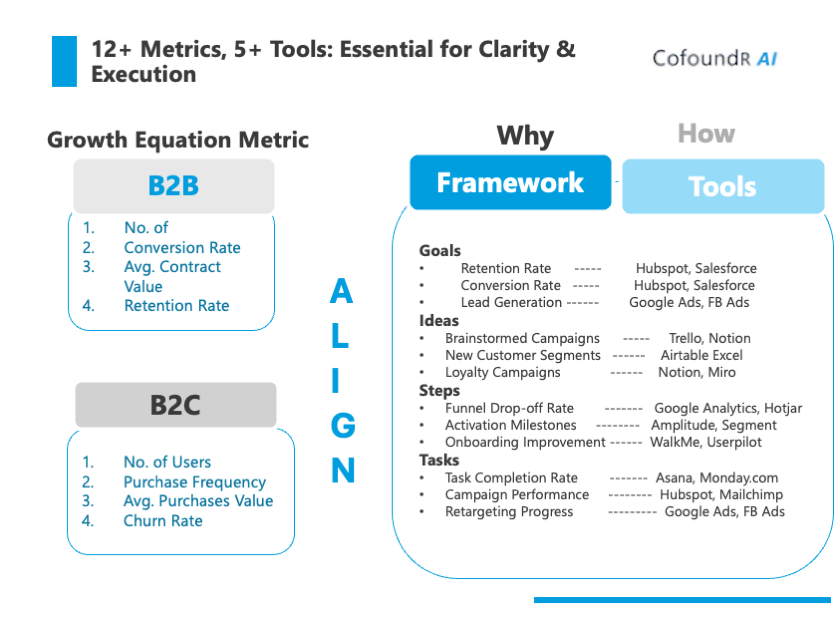
Most founders already rely on these tools to collect data and execute tasks. But the challenge isn’t collecting data—it’s integrating the metrics and frameworks to ensure every action aligns with your growth goals. Without this integration, tools risk creating fragmented insights instead of a cohesive strategy.
Key Takeaway:
By connecting growth equations (what), frameworks (why), and tools (how), founders can align their GTM strategy to achieve scalable, repeatable results.
Frameworks for Every Stage: Aligning Strategy with Execution
Scaling a startup isn’t a one-size-fits-all journey. The frameworks you apply need to evolve as your business grows. While early-stage startups may focus on basic metrics and execution frameworks, scaling companies often need to layer multiple frameworks to address the increasing complexity of their GTM strategy.
At each stage—from Seed to Series A and beyond—you’ll likely find that no single framework is sufficient. Instead, combining frameworks ensures you’re covering all aspects of GTM execution, from identifying bottlenecks to addressing strategic priorities.
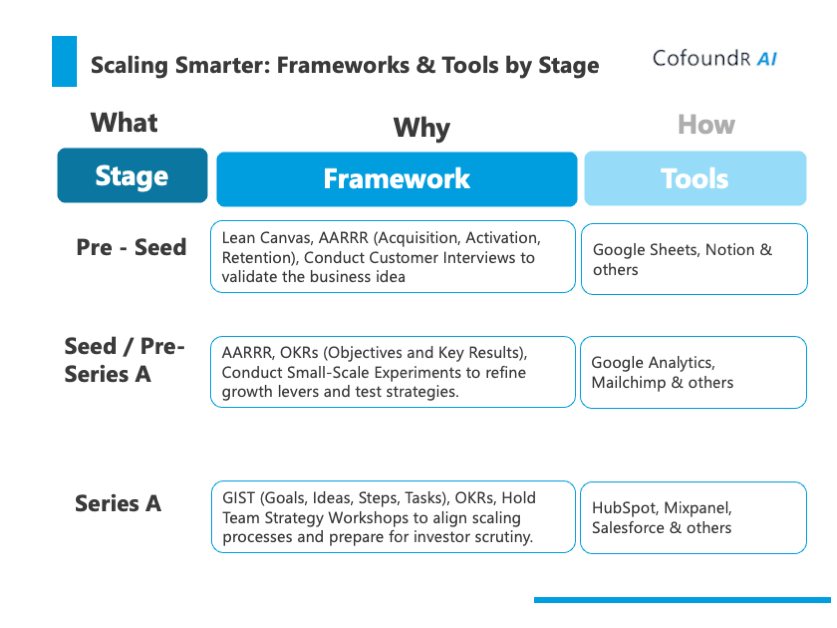
Example Frameworks by Stage:
Seed Stage: AARRR (Acquisition, Activation, Retention, Revenue, Referral) focuses on foundational growth levers.
Series A: GIST or OKRs (Objectives and Key Results) help manage growing teams and growth levers simultaneously.
Key Takeaway:
As your startup evolves, so do the demands on your GTM strategy. Often, it’s not about choosing one framework—it’s about combining multiple frameworks to create a scalable, repeatable process for growth and execution.
Hidden Costs of Manual GTM Strategy Execution
While frameworks like GIST and growth equations provide a roadmap, executing GTM strategies manually comes with hidden costs that are often underestimated.
As founders, you may already be juggling 10+ metrics across 5+ tools, spending 10-20 hours a month analyzing dashboards, spreadsheets, and reports. These efforts, while necessary, come with challenges:
Time Drain: Precious hours lost to manual analysis.
Decision Fatigue: Fragmented data increases cognitive load, slowing decision-making.
Inconsistent Execution: Without automation, frameworks are implemented unevenly, leading to missed opportunities.
Key Takeaway:
Manual execution creates inefficiencies that slow growth. Recognizing these hidden costs is the first step to optimizing your GTM strategy for scalability.
How AI Simplifies GTM Strategy Execution
AI-driven solutions overcome manual execution challenges by:
Streamlining Data Analysis: AI analyzes metrics across tools in seconds.]
Identifying Root Causes: Pinpoints what’s driving churn or inefficient conversions.
Creating Repeatable Processes: Automates insights, ensuring consistent execution.
For example, instead of manually analyzing CRM data for churn, AI highlights at-risk customers and recommends re-engagement campaigns—saving time and ensuring targeted action.
Key Takeaway:
AI transforms GTM execution from a fragmented, manual process into a scalable, automated system that empowers founders to focus on growth.
Ready to Take Your GTM Strategy to the Next Level?
If you found this blog insightful, don’t miss Why Founders Struggle with Series A GTM Readiness—our in-depth guide on growth equations. This blog builds on that foundation, focusing on frameworks like GIST to turn insights into actionable strategies.
We’re inviting a select group of founders to collaborate with us in co-creating a personalized AI-driven GTM tool.Spaces are limited—Join the Waitlist Now to shape the future of GTM strategy.