

Why Founders Struggle with Series A GTM Readiness
Scaling from early traction to Series A readiness is where many startups hit a wall. While growth metrics may look promising, investors are not just looking for numbers—they want to see a predictable and scalable GTM strategy.
The struggle lies in connecting the dots:
· What’s driving growth? Founders often rely on fragmented wins without understanding what’s truly repeatable.
Execution gaps: Managing multiple moving parts—growth drivers, frameworks, and execution—creates complexity that slows momentum.
Missed patterns: Without visibility into trends, inefficiencies creep in, and opportunities are lost.
To raise Series A confidently, founders need to shift focus: from chasing short-term wins to building a systematic GTM foundation that investors trust can scale.
Key Takeaway:
Series A success depends on a GTM strategy that’s predictable, scalable, and clearly aligned to growth drivers—not just a collection of wins.
The Growth Formula: How to Build Predictable and Scalable Growth
Growth doesn’t happen by chance—it’s driven by clear, measurable equations that show exactly where your GTM strategy succeeds or falls short. For Series A readiness, understanding and optimizing these drivers is critical.
Here’s how it breaks down:
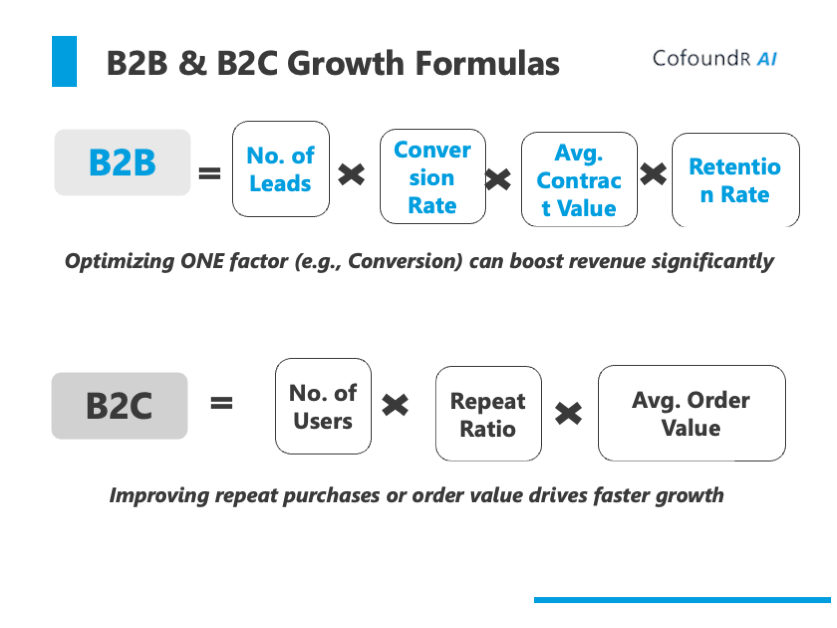
· B2B Growth Formula:
Number of Leads × Conversion Rate × Average Contract Value × Retention Rate
o Example: If you generate 100 leads monthly with a 5% conversion rate and an average contract of ₹50,000, the revenue is ₹2.5L. Improving conversion to 8% increases revenue to ₹4L—without changing lead volume.
· B2C Growth Formula:
Number of Users × Purchase Frequency × Average Order Value
o Example: If you have 1,000 users purchasing once monthly at an average order value of ₹500, revenue is ₹5L. Increasing purchase frequency to twice monthly doubles it to ₹10L.
These formulas do more than state the obvious—they uncover where inefficiencies lie.
For example:· Are your leads high quality but poorly converting?
· Are you losing customers due to low retention?
Key Takeaway:
Growth formulas turn guesswork into actionable insights, helping you pinpoint gaps, optimize performance, and build investor confidence in your GTM scalability.
Proven GTM Frameworks: Connecting the Dots Between Growth and Execution
Knowing the growth formula is the starting point, but execution determines success. This is where proven GTM frameworks come in:
GIST Framework (Goals, Ideas, Steps, Tasks):
Helps break down ambitious goals into manageable, actionable tasks. For example:
o A B2B SaaS startup might set a goal of doubling its leads. GIST turns this into actionable steps—idea generation for outreach campaigns, setting KPIs, and allocating resources effectively.
Bullseye Framework:
Enables startups to focus on the most impactful growth channels. For instance:
o A B2C company may test 10 channels (ads, referrals, partnerships) but find that influencer marketing and organic social drive the highest ROI.
By aligning these frameworks with your growth equations, you create a systematic, resource-efficient approach to execution. Investors look for this repeatability as a sign of Series A readiness.
Key Takeaway:
GTM frameworks bridge the gap between insights and execution, ensuring every decision prioritizes growth and scalability.
The Role of Automation and AI: Scaling Your GTM Without the Overwhelm
As your GTM strategy evolves, managing growth equations, frameworks, and execution becomes overwhelming. Founders often struggle to monitor multiple variables, identify patterns, and act quickly—all without disrupting workflows.
This is where AI-powered tools and automation simplify the process:
Simplify Complexity: AI integrates data from growth metrics and frameworks to provide real-time, actionable insights.
Identify Hidden Patterns: AI uncovers correlations and inefficiencies that manual analysis often misses, such as:
o A drop in user engagement caused by a recent marketing shift.
Streamline Execution: Automate repetitive tasks—tracking, reporting, and performance benchmarking—freeing your team to focus on scaling growth.
With automation and AI, every decision is precise, data-backed, and aligned with growth goals—building investor confidence that you can scale effectively.
Key Takeaway:
AI and automation remove guesswork, enabling faster execution, smarter decisions, and optimized resources—all essential for Series A success.
Conclusion: Build Investor Confidence with a GTM Strategy That Works
Raising Series A funding is about more than showcasing growth—it’s about proving that growth is predictable, repeatable, and scalable. By aligning growth formulas with frameworks and leveraging AI execution, you create a GTM system that builds investor confidence.
Key Takeaway:
A systematic GTM strategy—built on growth clarity, framework alignment, and AI-driven execution—is your ticket to Series A success.
Still navigating the maze of metrics without clarity? Explore our blog “Too Many Metrics, Not Enough Clarity” for practical insights on focusing on what truly drives growth.
Other founders are already joining us to co-create tailored solutions for their unique GTM challenges—don’t miss the opportunity to get exclusive access and build something that works for your business.