

Introduction
Scaling a startup requires more than just hard work—it demands focus and a strategic approach to growth. In our last blog, we highlighted commonly used and underutilized distribution channels across various startup stages and business models. Building on that, this blog will guide you on how to determine which channels can deliver the highest ROI and how to systematically experiment with them for maximum impact.
Laying the Foundation: Identifying High-ROI Distribution Channels
In our last blog, we discussed distribution channels that startups often overlook or underutilize. Now, the focus shifts to determining which of these channels can deliver the highest ROI for your specific goals.
For early-stage founders, prioritization is crucial. With limited resources, understanding the characteristics of high-ROI channels ensures that your efforts are targeted effectively. Here’s what defines a high-ROI channel:
- Scalability: Can the channel grow without proportional increases in costs?
- Engagement Potential: Does it align with your audience’s behavior and preferences?
- Resource Efficiency: Can it be tested using existing tools and minimal investment?
For example:
B2B SaaS: Channels like webinars or LinkedIn outreach are often ideal for generating leads.
B2C: Referral programs or partnerships with micro-influencers can be highly effective.
By keeping these traits in mind, let’s explore how you can systematically test and validate these channels.
A Step-by-Step Guide to Experimenting with Distribution Channels
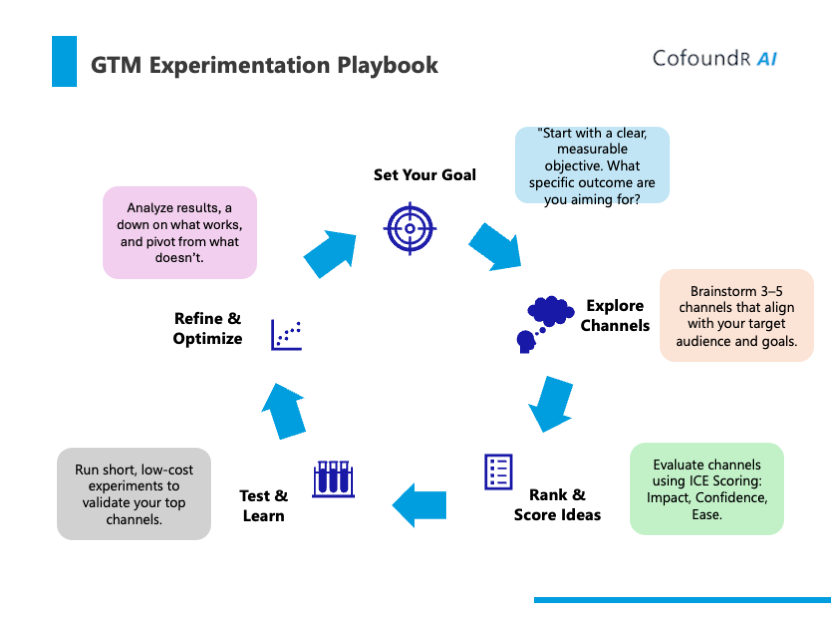
Experimentation is the bridge between theory and execution. Follow this structured approach to make experimentation practical and effective:
- Step 1: Define Your Objective
Start with a clear, measurable goal. For example:
Increase demo sign-ups by 15% using LinkedIn outreach.
Improve email open rates by 20% for dormant leads.
- Step 2: Brainstorm Potential Channels
Identify 3–5 channels that align with your goal, such as:
B2B SaaS: Webinars, partnerships, or LinkedIn ads.
B2C: Social media campaigns, referral programs, or influencer collaborations.
- Step 3: Prioritize Using ICE Scoring
Use the Impact, Confidence, and Ease (ICE) framework to evaluate potential channels:
Impact: Will this channel significantly affect your goal?
Confidence: Do you have supporting data or qualitative insights?
Ease: Can this channel be tested with minimal resources?
- Step 4: Design Low-Cost Experiments
Keep experiments short and resource-light. Examples include:
Testing personalized LinkedIn outreach for B2B leads.
Running small-budget Instagram ads targeting niche audiences.
- Step 5: Monitor and Refine
Leverage analytics tools to track performance metrics such as:
Engagement rates (click-throughs, opens).
Conversion metrics (demo sign-ups, purchases).
Using Existing Tools to Simplify GTM Strategy Experiments
Experimentation doesn’t have to mean reinventing the wheel. Leverage tools already in your tech stack to streamline processes:
CRM Insights
B2B SaaS: Identify high-conversion outreach methods.
B2C: Track customer journey patterns to optimize referral programs.
Google Analytics
Identify drop-off points and optimize user journeys.
Segment audiences to create personalized campaigns.
Marketing Automation Tools
Platforms like HubSpot or Mailchimp can help run A/B tests.
Social Media Analytics
Use insights to test content formats like videos or carousels.
Measure engagement on LinkedIn for B2B campaigns.
Automation Platforms
Use Zapier or Airtable to consolidate and automate data tracking.
How to Analyze Results and Make Data-Driven Decisions
Experiments are only as valuable as the insights they generate. Here’s how to analyze results effectively:
Define Success Benchmarks
Set clear metrics like demo bookings or CTR before starting.
Compare Channel Performance
Analyze metrics like engagement and conversion rates to identify top-performing channels.
Spot Trends and Anomalies
Identify consistent performers and refine underperforming channels.
Use Visualizations
Tools like Tableau or Google Data Studio can help identify patterns.
Iterate and Improve
Amplify high-performing channels, refine weaker ones, and reallocate resources accordingly.
Exploring Frameworks Behind Successful GTM Strategies
While the steps above may seem intuitive, they’re informed by proven frameworks such as:
- Bullseye Framework: Prioritize channels by narrowing down from potential options to those with the highest ROI.
- Lean Startup Methodology: Adopt iterative cycles of build, measure, and learn for continual improvement.
- ICE Scoring: Use this prioritization tool to balance ambition and feasibility in your experiments.
These frameworks enhance credibility and ensure that your GTM efforts are scalable, data-driven, and grounded in methodologies that work.
Key Takeaways: Simplifying GTM for Early-Stage Founders
- Experimentation is Essential: Reduce risks and uncover high-impact channels with resource-light tests.
- Leverage Existing Tools: Your CRM, Google Analytics, and marketing platforms offer powerful insights.
- Frameworks Provide Structure: Steps align with frameworks like Bullseye, Lean Startup, and ICE Scoring for scalable growth.
- Iterative Approach: Treat every experiment as part of a cycle to refine your GTM strategy continually.
- Data-Driven Decisions: Combine metrics and qualitative insights to optimize your distribution efforts.
Let’s Co-Create Your GTM Strategy
We’re partnering with founders to tackle GTM challenges and co-create actionable, data-driven solutions tailored to their growth journey. If you’d like to explore how systematic experimentation can transform your GTM strategy, let’s connect. 🚀