
The Challenge of Tracking Metrics
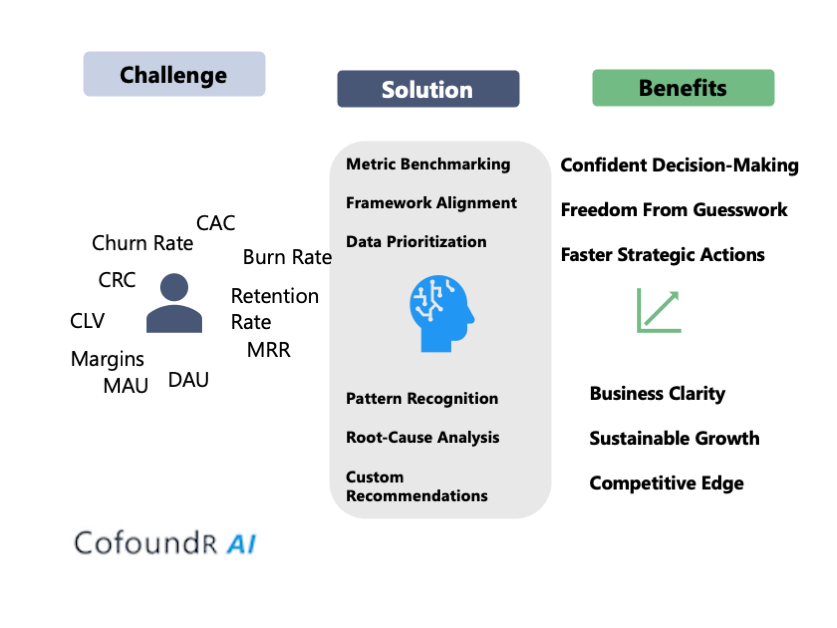
Startups often find themselves juggling a seemingly endless list of metrics, each appearing vital to success. From Customer Acquisition Cost (CAC) to Monthly Recurring Revenue (MRR), these numbers promise insights but often deliver confusion. Founders face a dual challenge: figuring out what truly matters and connecting the dots to drive actionable results.
While experts like Harvard Business Review emphasize focusing on a handful of metrics to avoid analysis paralysis, the reality is far more complex. The 2024 Global Startup Ecosystem Report by Startup Genome reveals that many founders grapple with information overload, attempting to track 10-15 metrics at a time.
This disconnect—between expert advice and the reality of managing a growing startup—leads to diluted focus and stalled decision-making. Without clarity, early-stage startups risk missing the very opportunities they need to scale and thrive.
A Real-World Example
Imagine you’re an early-stage founder in Enterprise Tech, offering software solutions. You’ve raised a small seed round, achieved some visibility on product-market fit, but full traction is still a work in progress. Like many founders, you’re tracking metrics such as CAC, CLV (Customer Lifetime Value), churn rate, and MRR to understand every angle of your growth.
On the surface, some metrics might seem strong: your MRR stands at ₹6M, and your CLV is ₹24,000, which appears promising. However, a closer look reveals critical gaps. For instance, your churn rate is 6%, but without industry benchmarks, it’s hard to gauge whether that’s acceptable. In reality, the benchmark churn rate is 3-4%, indicating that you’re losing customers faster than competitors.
Even with solid CLV and MRR, the churn issue poses a significant threat. Instead of focusing on retention strategies, you’re directing more resources toward acquisition to compensate—leading to inefficiencies and missed opportunities. This example highlights a common struggle: metrics in isolation can mask deeper issues, leaving founders overwhelmed and unable to prioritize effectively.
Why It’s Hard to Prioritize
Prioritizing metrics isn’t just about knowing which ones matter—it’s about making sense of how they interconnect. Founders often track metrics like CAC, CLV, and churn rate, but the relationships between them are rarely obvious. For example, improving retention might seem straightforward, but what if the root cause lies in acquisition quality or activation rates?
The human brain, no matter how analytical, struggles to synthesize 10-15 interdependent metrics at once—especially in real time. Add to this the pressure of competing priorities like growth, retention, and acquisition, and it’s no surprise that founders face decision fatigue.
This isn’t just a challenge of data overload; it’s a challenge of turning insights into action. As startups scale, these complexities multiply, leaving founders with fragmented insights and stalled strategies.
AI: Bridging the Gap
This is where AI steps in to transform how startups manage metrics. Unlike manual methods that leave founders overwhelmed, AI connects the dots between scattered data points, uncovering patterns and relationships that might otherwise go unnoticed.
For example, AI doesn’t just highlight that your churn rate is 6%; it compares it against real-time benchmarks and suggests actionable steps—like improving activation metrics to align with the 3-4% industry standard. By analyzing interdependencies between metrics, AI transforms confusion into clarity.
Machine learning enhances this process by continuously learning from your data. It surfaces insights founders might miss, adapts dynamically to changes, and ensures your focus stays on metrics that drive results. AI doesn’t just provide data—it delivers the context and confidence needed to act.
Real-Time Insights for Growth
In today’s competitive landscape, real-time intelligence isn’t a luxury—it’s essential. AI enables founders to:
Adapt Strategies Dynamically: Respond to churn, acquisition costs, or retention challenges immediately.
Uncover Hidden Patterns: Spot relationships between metrics, like how activation rates influence customer retention.
Allocate Resources Effectively: Identify high-performing channels early and maximize ROI.
Predict Opportunities: Stay ahead by identifying trends and insights before competitors do.
By transforming scattered metrics into actionable strategies, AI empowers startups to focus on growth and sustainability without being overwhelmed.
Be the Founder Who Sees Ahead
In today’s competitive startup landscape, success isn’t about tracking everything—it’s about focusing on what matters most and acting decisively. AI bridges the gap between data and clarity, helping founders move from juggling numbers to driving results.
Be among the select few early-stage founders to unlock this advantage. Join the waitlist now to secure exclusive early access benefits and take the first step toward transforming your startup’s growth strategy.