

Why Distribution Channels Matter in Scaling Your Startup
Scaling a startup is more than just building a great product; it’s about ensuring that product reaches the right customers through the most effective channels. Founders often default to familiar methods, but growth demands exploring underutilized distribution strategies that deliver higher ROI and scalability.
A compelling data point? The average B2B customer requires 62.4 touchpoints across 3.5 channels before converting into a deal (10 Benchmarks Report, 2024). This highlights why startups must embrace multi-channel strategies, balancing commonly used channels with untapped opportunities.
In this blog, we’ll explore:
- Channels founders commonly rely on across funding stages.
- Underrated channels that can unlock untapped growth.
- Key metrics to link channel success with fundraising outcomes.
- Actionable strategies to build a scalable GTM system tailored to your startup’s needs.
Commonly Used vs. Underutilized Channels Across Stages
For B2B Startups
B2B startups often stick to direct sales, LinkedIn outreach, and email marketing—strategies that feel familiar but may not scale efficiently. Here’s how channel reliance evolves across stages:
Pre-Seed: Founders lean on personal networks and referrals. However, channels like community building and content marketing remain underutilized despite their ability to establish early credibility.
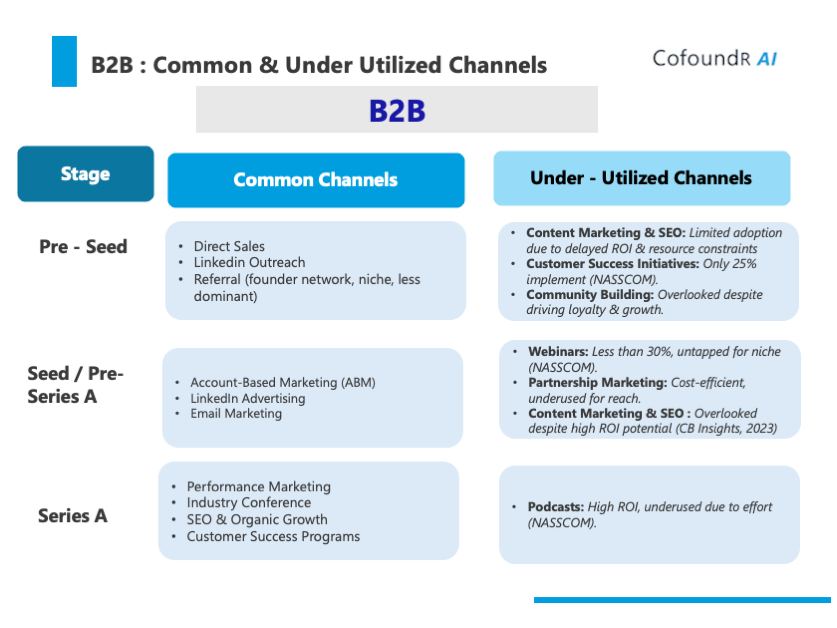
Seed: Webinars gain traction but are used by less than 30% of startups, despite delivering high-quality leads. Similarly, partnership marketing—collaborating with complementary brands—offers cost-effective audience access but is often overlooked.
Series A: SEO becomes a focus, yet podcasts and customer success programs remain underutilized. These strategies drive retention and upsell metrics, which are critical for scaling growth.
For B2C Startups
B2C startups often rely on social media ads, performance marketing, and influencer campaigns. However, significant opportunities lie in overlooked channels:
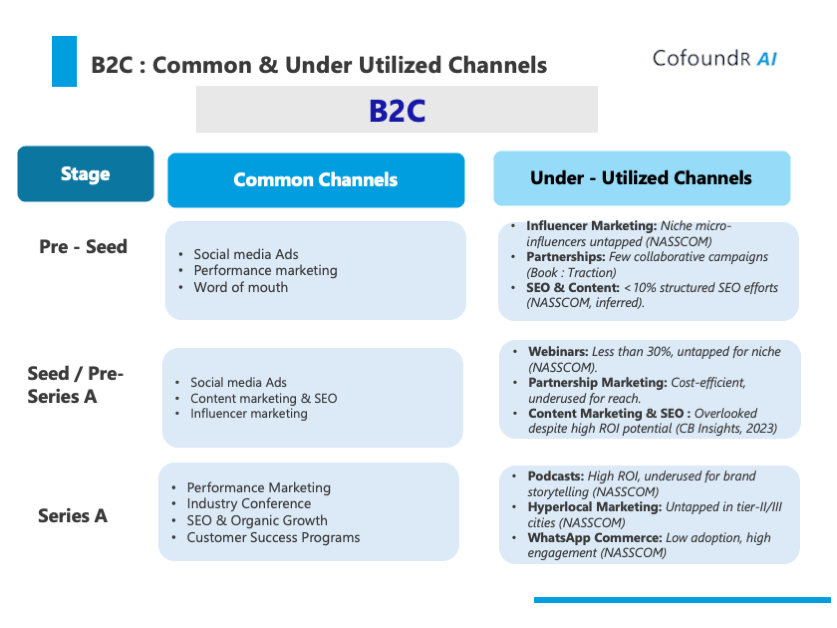
Pre-Seed: Micro-influencer marketing drives niche engagement but is often dismissed. Early partnerships with complementary brands can provide mutual audience access at minimal cost.
Seed: Webinars—traditionally seen as B2B tools—can create deep engagement for niche audiences. WhatsApp commerce, with its 95% open rates, offers an untapped avenue for direct engagement.
Series A: Hyperlocal marketing, especially in tier-II/III cities, is a game-changer for geographic expansion. Few startups tap into this despite the high ROI and scalable potential.
How to Experiment and Optimize Distribution Channels
For founders, channel experimentation is about balancing creative risks with measurable returns. Here’s how to get started:
Start Small: Run low-cost pilots on channels like webinars or podcasts to assess traction before scaling.
Use Feedback Loops: Ask users what resonates—whether it’s social media, emails, or niche forums—and let these insights refine your approach.
Test Continuously: Conduct A/B tests for copy, content types, and platforms to identify high-impact strategies.
Track Channel Metrics: Use data to allocate resources dynamically. For example, a webinar yielding 3x CAC improvement compared to ads could justify scaling it further.
Metrics That Connect Channel Efficiency to Fundraising Success
Fundraising isn’t just about using the right channels—it’s about presenting their measurable impact to investors. Key metrics to monitor include:
Customer Acquisition Cost (CAC): Show how you reduced CAC by shifting to high-ROI channels like partnerships or podcasts.
Channel ROI: Highlight metrics like a 40% ROI boost from WhatsApp commerce, which is often untapped by B2C startups.
Conversion Rates: Showcase outperforming channels, e.g., “Our influencer marketing campaigns deliver a 20% conversion rate, double the industry average.”
Retention Metrics: Demonstrate long-term value by tying customer success programs to improved retention and upsells.
Case Study: Leveraging Webinars and Podcasts for B2B Growth
One standout example is DRUID AI, a B2B SaaS startup that scaled using webinars and podcasts—both underutilized by early-stage companies.
Webinars: DRUID hosted industry-specific webinars addressing challenges in banking and retail, showcasing their chatbot technology.
Podcasts: Their series on automation trends not only boosted brand authority but also generated 20% of inbound leads.
Results: These efforts led to a 25% webinar attendee-to-lead conversion rate, with a 40% uplift in social media engagement.
For founders, this case demonstrates how strategic use of unconventional channels can drive meaningful results.
Actionable Takeaways for Founders: Building a GTM Advantage
Experiment Early: Use niche channels like micro-influencer marketing or WhatsApp commerce to gain an edge.
Prioritize Scalability: Invest in channels like SEO that grow exponentially over time.
Align Metrics with Fundraising: Highlight CAC-to-LTV ratios and ROI improvements when pitching to investors.
Balance Familiar and New: Pair proven strategies (e.g., performance marketing) with high-ROI experiments (e.g., webinars).
Customize by Audience: Tailor channels to your target market—B2B startups should focus on thought leadership, while B2C can explore hyperlocal marketing for regional growth.
If This Blog Resonated With You
For founders ready to explore high-impact growth strategies, we’ve curated a [19-Channel Guide Inspired by the Traction Book to help you experiment and scale effectively.
Want a tailored GTM tool designed for your startup? Join us in co-creating the future of distribution strategy. Join the Waitlist Here to gain early access.