
Scaling a startup from seed to Series A is a journey full of opportunities and challenges. While early traction often comes from familiar channels like direct sales or email marketing, the next phase of growth requires more than tactical execution. Founders need a clear, repeatable, and data-driven GTM strategy to inspire investor confidence and unlock scalable growth.
In our first blog, we explored common and underutilized distribution channels that startups can leverage to drive growth. In the second blog, we discussed how founders can validate these channels through systematic experimentation. This blog builds on those insights by using a real-world case study to uncover actionable lessons for crafting a scalable GTM strategy.
Case Study: Lessons from an Indian HR Tech Startup
We recently spoke with the founder of an Indian HR tech startup—a marketplace connecting offshore IT professionals with global enterprises for mid-to-long-term projects—as they prepared for a fundraising round. Their journey offers valuable lessons for startups refining their GTM approach.
Their achievements include:
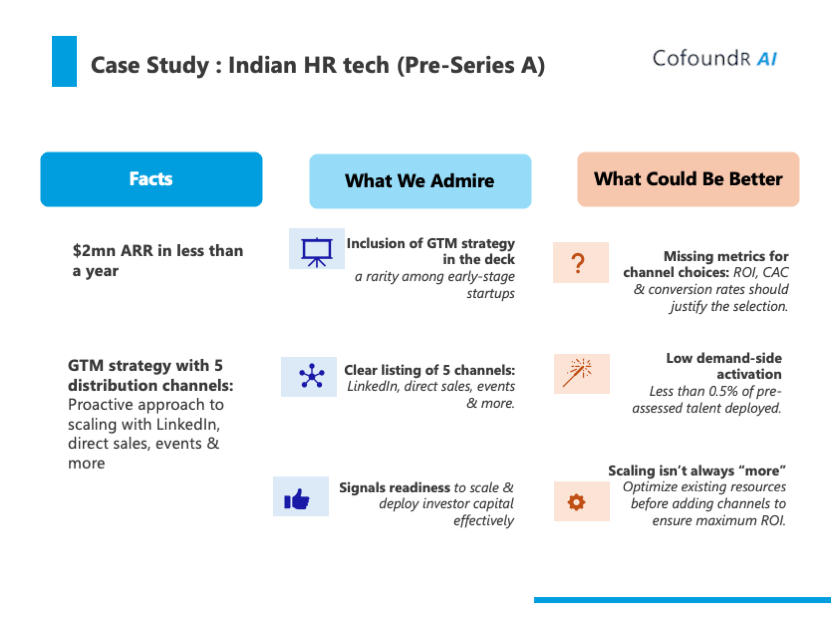
- $1M ARR in under a year, showcasing their ability to build traction quickly.
- A thoughtfully crafted GTM strategy in their pitch deck, which outlined five distribution channels, including LinkedIn, direct sales, and events—a level of detail not commonly seen in early-stage decks.
What We Admire
Including a GTM strategy in the deck is a significant achievement; many founders overlook this critical element. Listing additional distribution channels signals a proactive approach to scaling. This offers a valuable takeaway for startups preparing for investor discussions: outlining your GTM roadmap can demonstrate readiness to deploy capital effectively.
What Could Be Improved
While the strategy is well-laid out, it lacked metrics to justify the choice of these channels. Investors would have benefited from insights such as conversion rates, ROI projections, or early experiment results. Such data helps answer key questions: Where is the capital going? Why were these channels chosen? What can investors expect from these initiatives?
Additionally, some investors might question expanding distribution channels over activating existing demand. With less than 0.5% of their pre-assessed talent deployed, engaging enterprises to hire talent already on the platform could unlock immediate growth. Sometimes, scaling isn’t about adding more—it’s about optimizing what you’ve already built.
Foundational Pillars of a Scalable GTM Strategy
A strong GTM strategy isn’t just about laying out growth plans—it’s about ensuring those plans are scalable, repeatable, and resilient. By anchoring your approach to these foundational pillars, you can build confidence with investors while avoiding common pitfalls.
- Channel Selection and Validation
Choosing the right distribution channels is critical, but so is validating why they work. Including five distribution channels in the HR tech startup’s deck was commendable and showed readiness to scale. However, the absence of metrics like conversion rates or CAC trends left room for doubt. Startups should prioritize a few high-impact channels and validate their decisions with ROI data to strengthen investor confidence.
- Demand-Side Activation
For marketplaces, balancing supply and demand is critical. While the HR tech startup focused on expanding channels, some investors may see greater value in activating demand-side enterprises already on the platform. Personalized outreach and tailored onboarding can help enterprises hire seamlessly, driving higher platform utilization.
- Retention as a Growth Lever
Retention is a clear indicator of product-market fit. For HR tech, low activation rates suggested an opportunity to re-engage both developers and enterprises. Early retention metrics (e.g., engagement within 30–90 days) and automated touchpoints like milestone emails can keep users active, maximizing the return on acquisition efforts.
Why These Pillars Matter
Investors value GTM strategies that demonstrate thoughtfulness, validation, and adaptability. By addressing channel validation, demand-side optimization, and retention, startups can present a roadmap that balances ambition with execution readiness.
Scaling a startup is as much about strategy as execution. This blog covered actionable insights for building a scalable GTM strategy and highlighted key lessons from a real-world case study.
Stay tuned for Part 2, where we’ll explore investor expectations, execution strategies, and more. Let’s bridge the gap between where you are today and where you aim to be tomorrow.
Exciting Opportunity: We’re inviting a select group of founders to co-create a fully personalized and data-driven GTM strategy. This exclusive program will help you prepare for your next fundraising milestone or market expansion with a tailored, automated approach.
Don’t miss the chance to refine your strategy and unlock scalable growth. Be part of this limited opportunity to collaborate with us and take your startup to the next level. Sign up to be among the few selected.
Hi, this is a comment.
To get started with moderating, editing, and deleting comments, please visit the Comments screen in the dashboard.
Commenter avatars come from Gravatar.